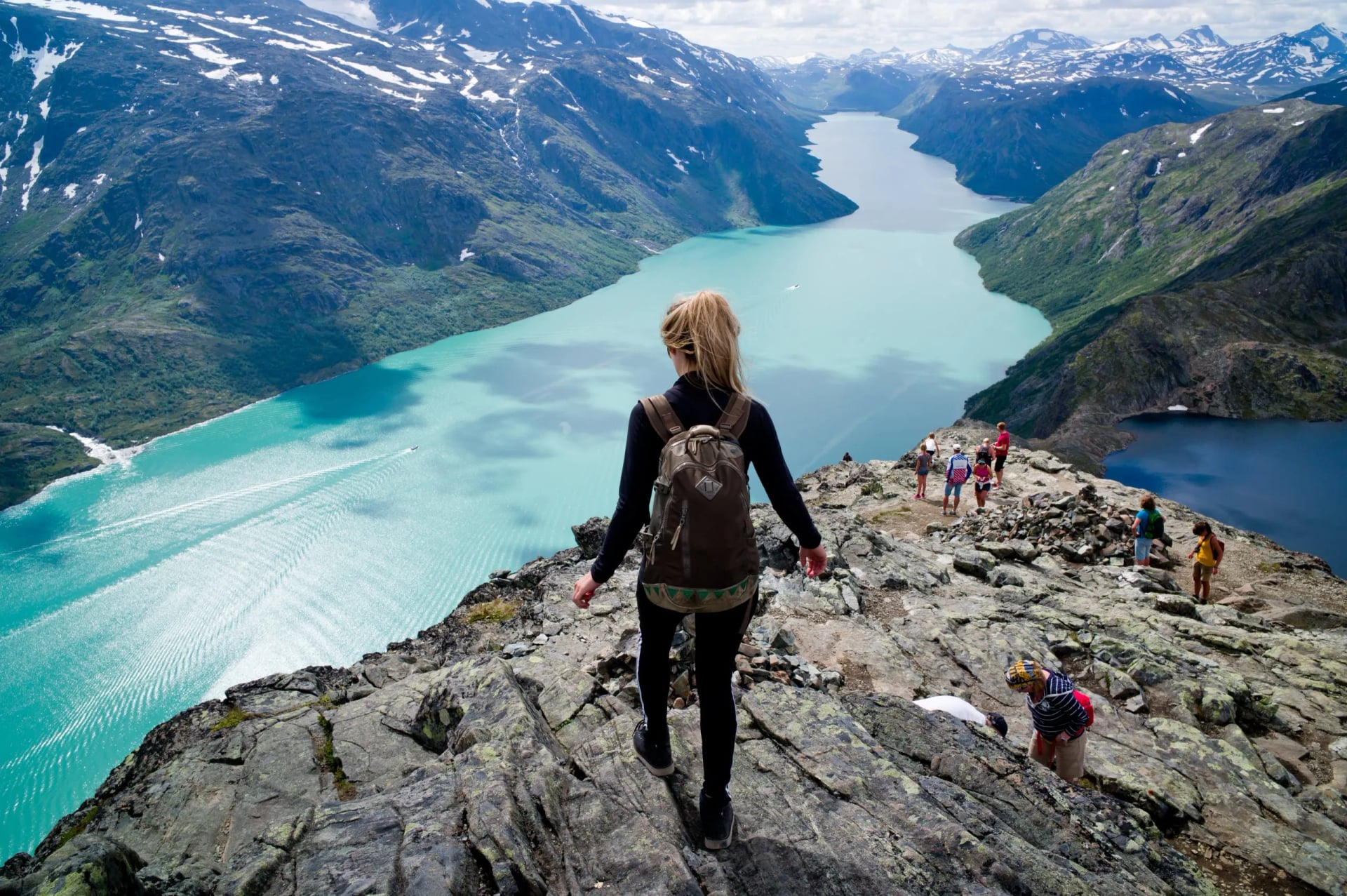
Hiking in Norway: 12 Best Day Hikes and Multi-Day Treks
Norway's 12 best hikes, from Trolltunga to six-day hut treks, with distance, climb, start and season for each, plus DNT huts, costs and the right to roam.
Quick links
Don't want to read all this?
We've planned 2,000+ hiking trips. Send your dates, fitness and group size — we'll map the route and book every night.



Norway is a country carved by ice and shaped by water. You walk above fjords that cut far inland, cross bare plateaus where wild reindeer graze and climb ridges between green glacier lakes. North of the Arctic Circle, the summer sun never sets.
The country makes it easy to stay out for days. The Norwegian Trekking Association (DNT) marks over 23,000 km of summer trails and runs over 600 huts, staffed in summer from mid-June to mid-September. The right to roam lets you camp on open land almost anywhere else.
The best hikes range from a half-day climb above Reine to hut-to-hut treks of three to six days through Jotunheimen, Rondane and Trollheimen.
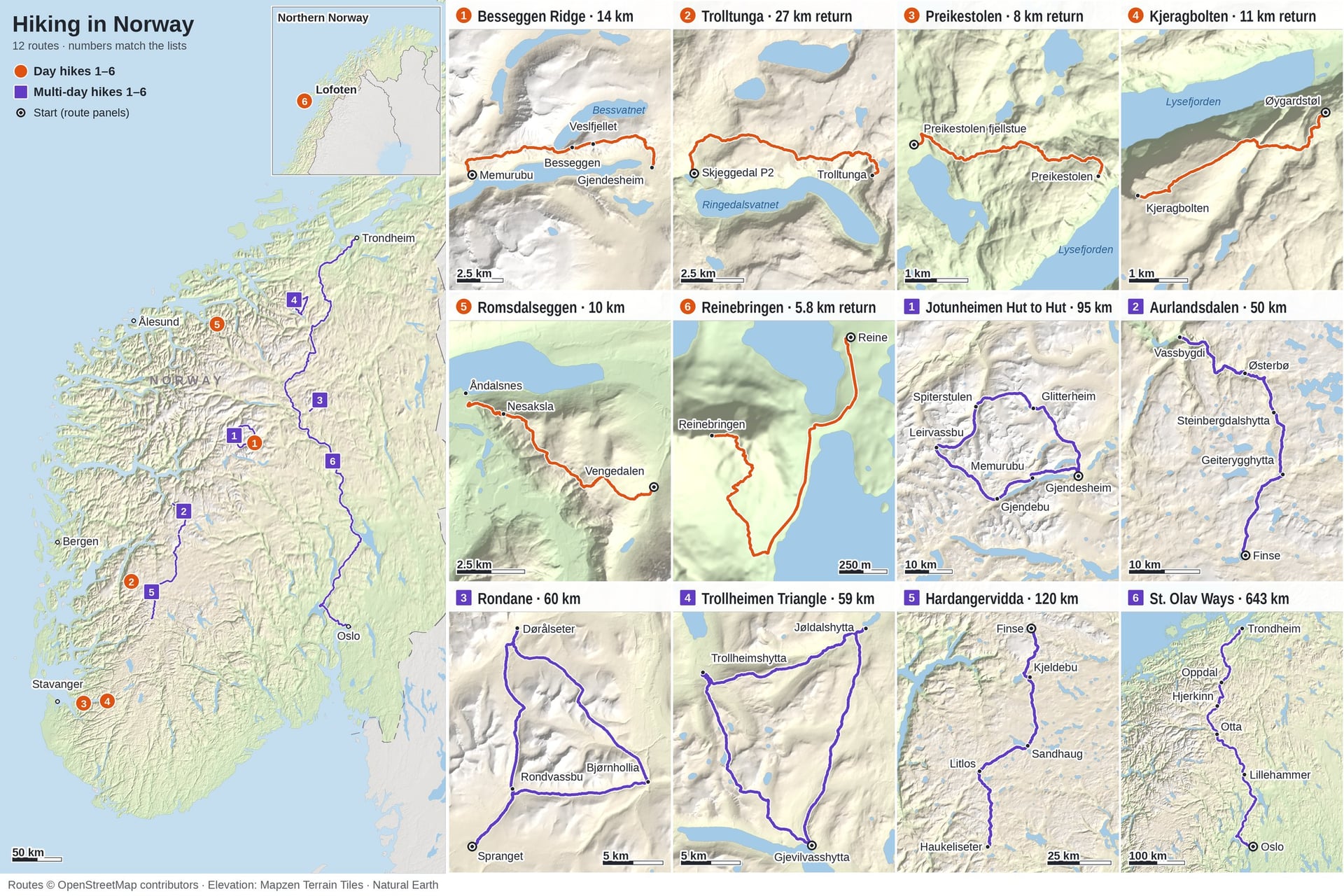
The 6 Best Day Hikes in Norway
Norway's famous day hikes climb from a fjord or a mountain lake to a cliff edge, a rock ledge or a narrow ridge. Most of them start from a paid car park or a boat.
Hike | Region | Distance | Time | Climb | Season |
Besseggen Ridge | Jotunheimen | 14 km one way | 6 to 8 hours | About 1,020 m | June to mid-September |
Trolltunga | Hardanger | 27 km return | 8 to 12 hours | 1,200 m | June to September |
Preikestolen | Lysefjord | 8 km return | 4 to 5 hours | 500 m | All year, guide advised in winter |
Kjeragbolten | Lysefjord | 11 km return | 5 to 6 hours | 750 m | June to September |
Romsdalseggen | Åndalsnes | 10 km one way | 5 to 8 hours | 970 m | Mid-June to September |
Reinebringen | Lofoten | 5.8 km return | 1 to 2 hours on the steps | 484 m | May to September |
1. Besseggen Ridge
Distance: 14 km one way, from Memurubu back to Gjendesheim
Time: 6 to 8 hours
Climb: about 1,020 m, up to Veslfjellet at 1,743 m
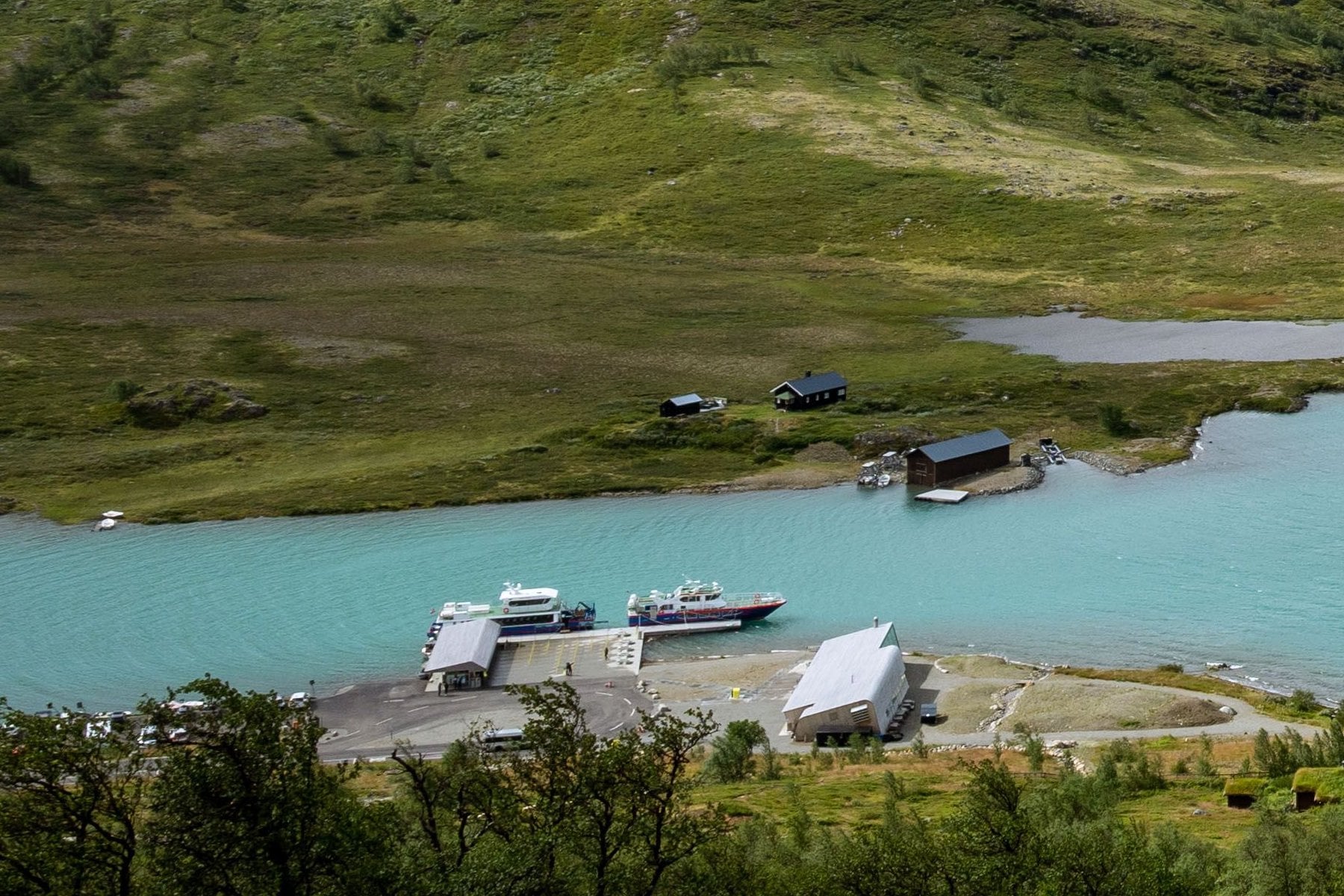
Start: the Gjende boat from Gjendesheim to Memurubu, NOK 260 one way in 2026
Season: June to mid-September, while the boat runs
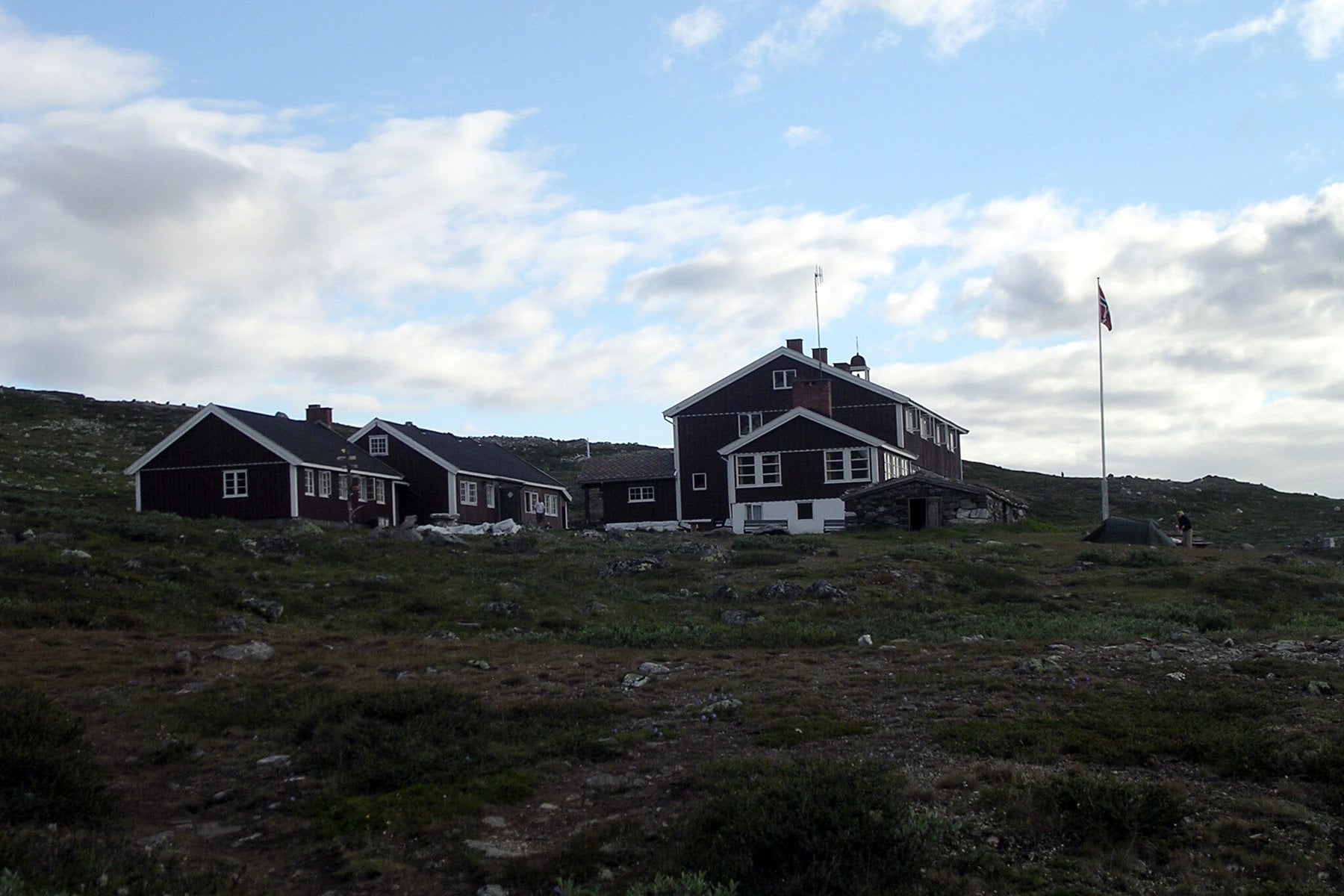
Where to sleep: Gjendesheim, a 185-bed DNT lodge, or Memurubu, a private staffed lodge
Best for: a first big ridge walk, with a boat ride to the start
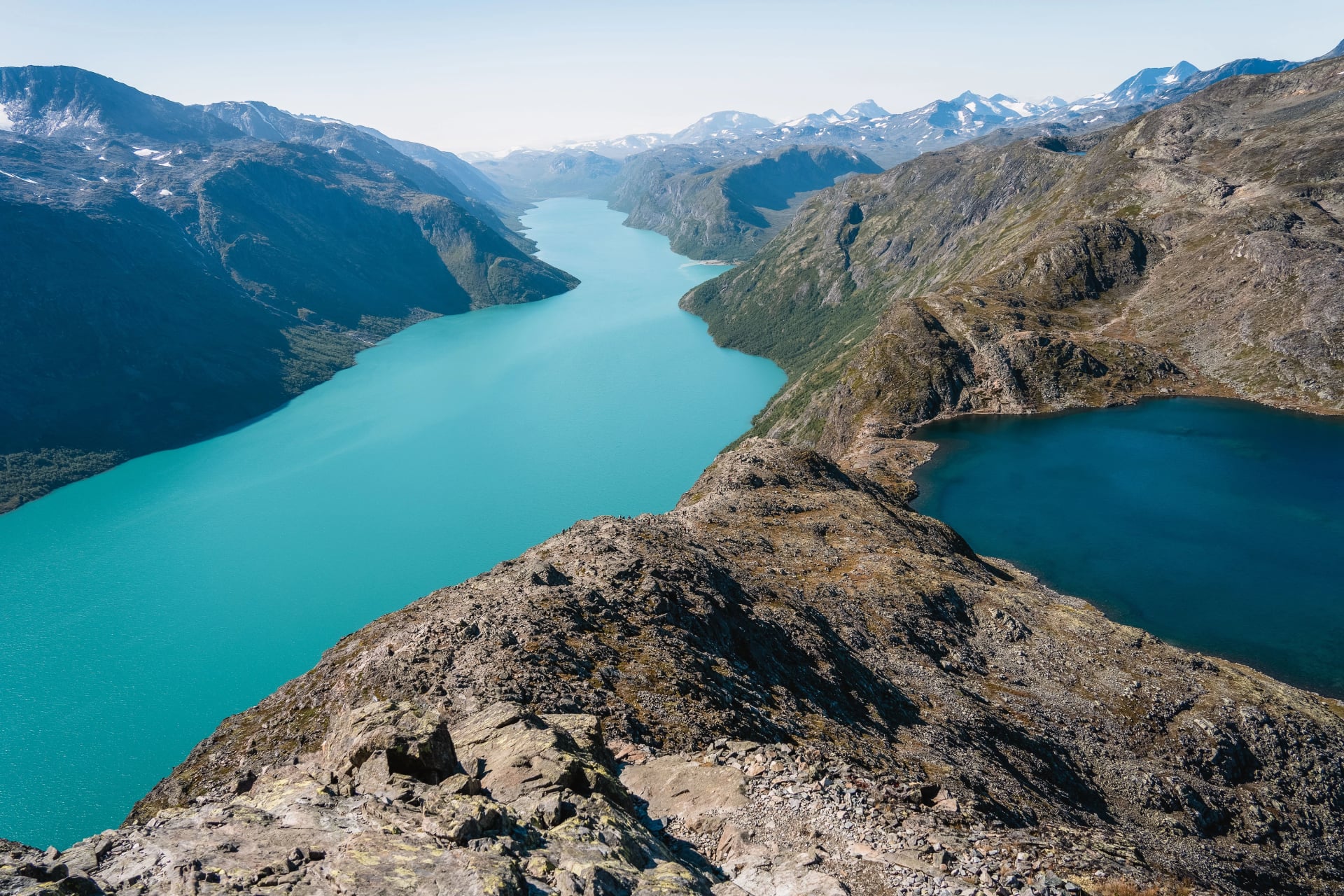
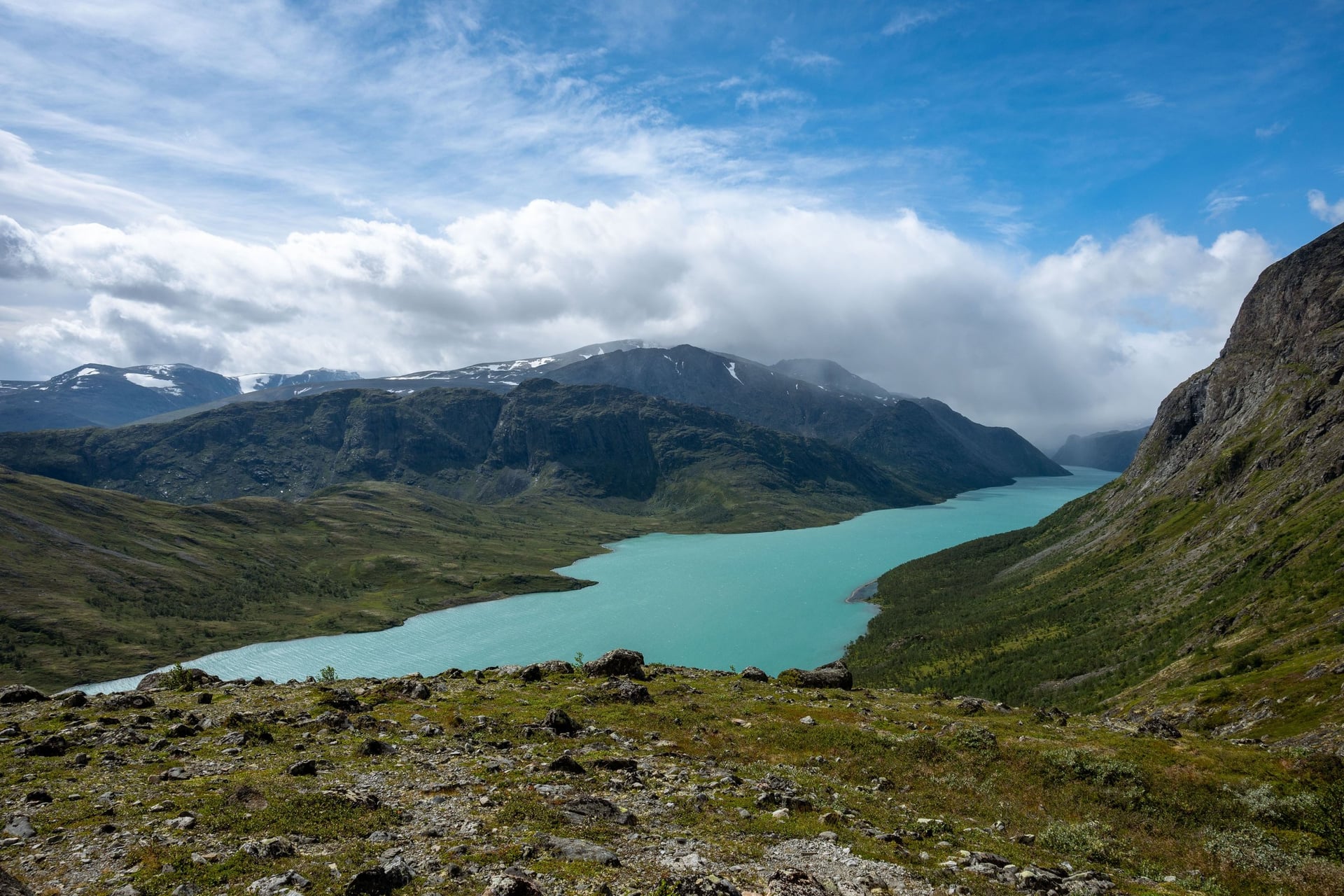
Besseggen is Norway's most famous ridge walk, and the Gjende boat company calls it the country's most hiked mountain trail. It runs between the green water of Lake Gjende and the deep blue Bessvatnet, with Gjende about 400 m below you. It is narrow but not technical, though you use your hands in places.
Over 50,000 people walk it each year, so start early to stay ahead of the crowds. The regular first boat leaves Gjendesheim at 07:45, with an extra 07:00 sailing on busy summer days. The long descent to Gjendesheim is hard on the knees, and our Jotunheimen hiking guide covers the park's other routes.
2. Trolltunga
Distance: 27 km return from the P2 car park at Skjeggedal, or 20 km from P3 at Mågelitopp
Time: 8 to 12 hours from P2
Climb: 1,200 m in all, to the rock tongue at 1,180 m
Start: Skjeggedal, off the road at Tyssedal 6 km from Odda, with a summer shuttle bus from Odda
Season: 1 June to 30 September; a guided hike is recommended the rest of the year
Where to sleep: Odda or Tyssedal
Best for: fit hikers ready for a very long day
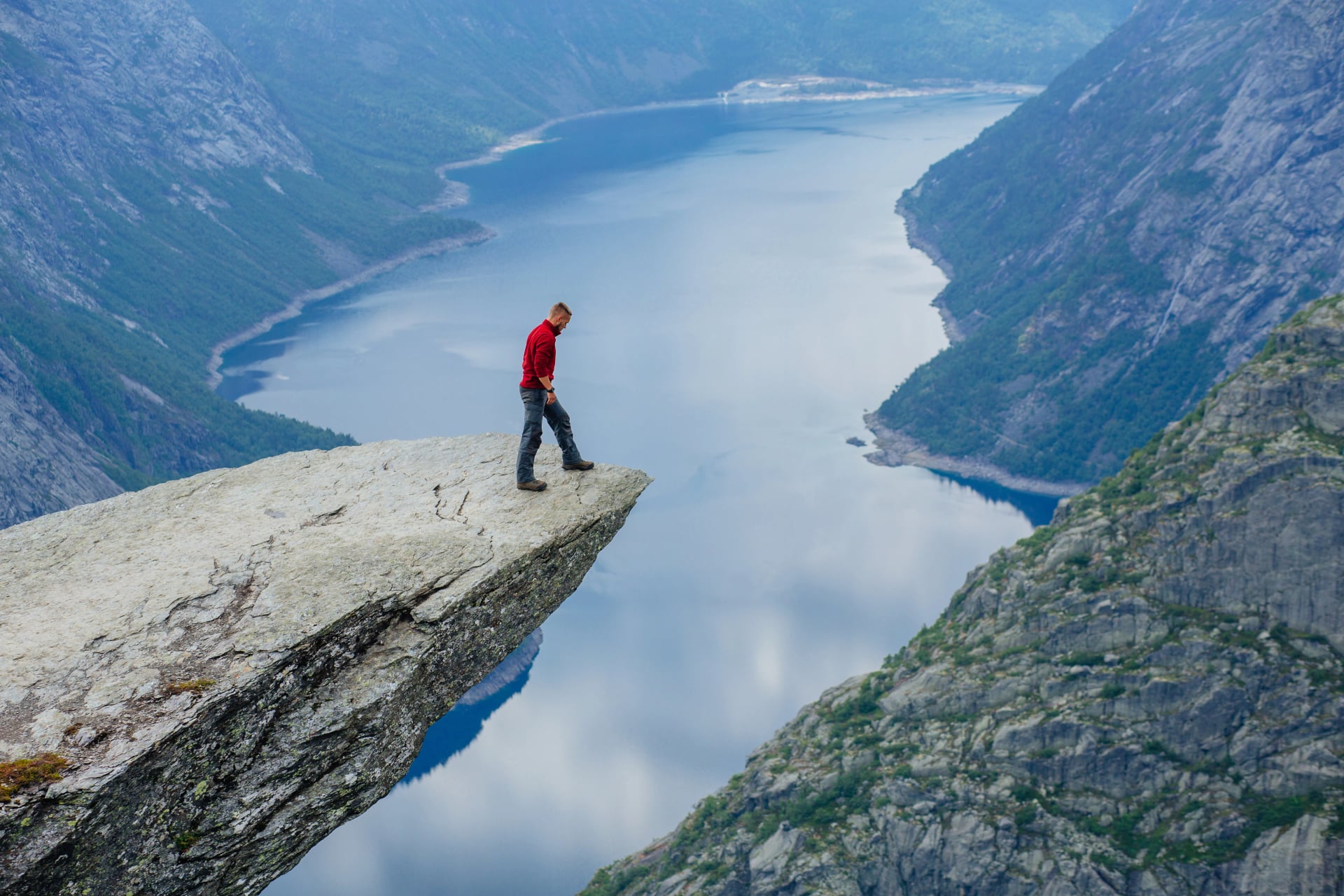
Trolltunga, the Troll's Tongue, is a slab of rock jutting out from a cliff 700 m above Lake Ringedalsvatnet. It is the longest and most demanding of Norway's classic day hikes, and about 85,000 people made the trip in 2025, up from 800 in 2010.
There are no shops or water on the way, so carry all your food and water from P2, where the toilets are. Mountain rangers staff a rescue hut from mid-May to mid-October, and call-outs have fallen sharply since they started in 2017. Start early so you finish before dark.
3. Preikestolen
Distance: 8 km return
Time: 4 to 5 hours
Climb: 500 m in all
Start: the Preikestolen car park beside Preikestolen BaseCamp, about 50 minutes by bus from Stavanger
Season: all year; a guide is recommended in winter
Where to sleep: Preikestolen Fjellstue at the trailhead, or Stavanger
Best for: families and first-time hikers with decent fitness
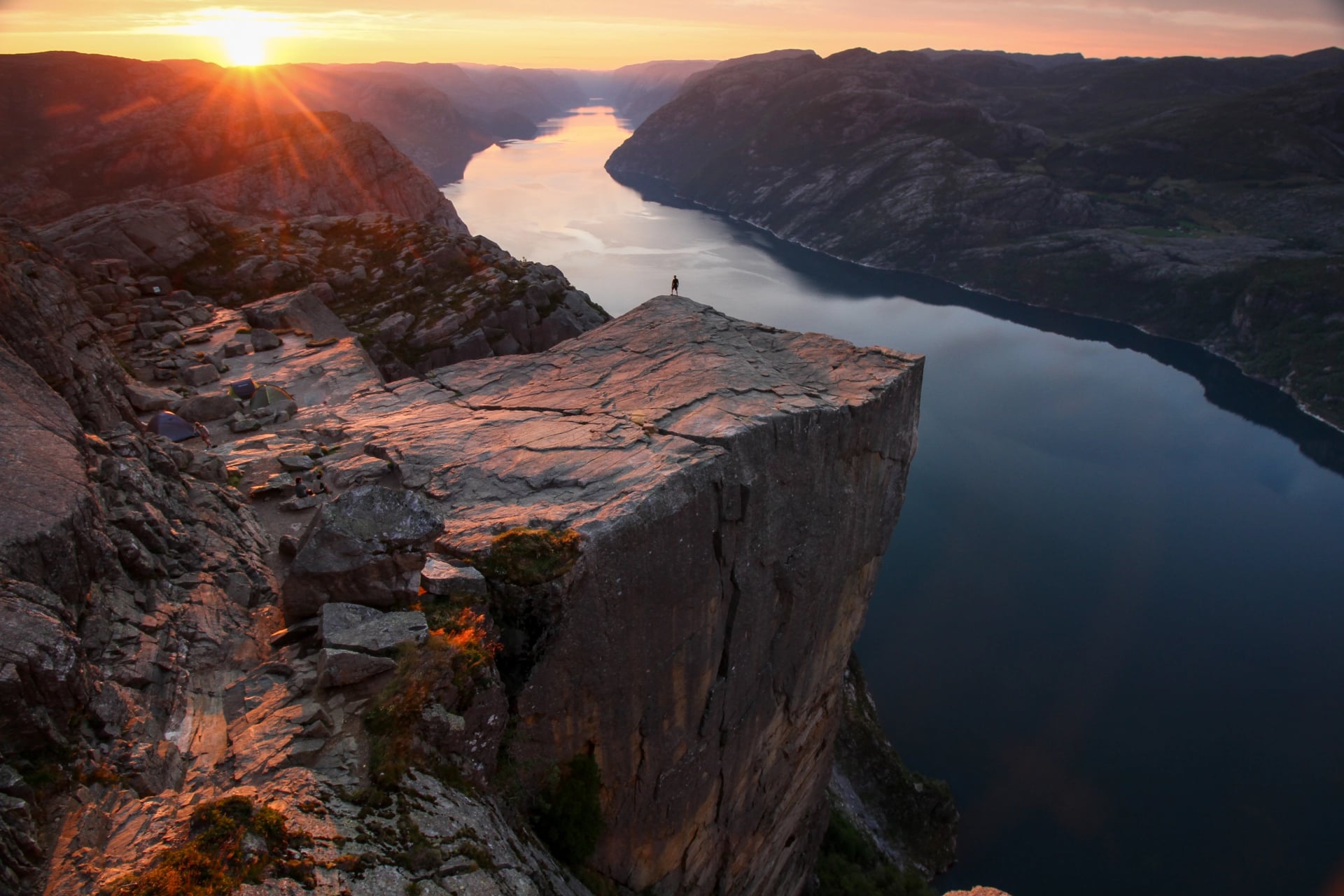
Preikestolen, or Pulpit Rock, is one of Norway's most photographed viewpoints: a flat-topped cliff 604 m above the Lysefjord. The trail is well marked and suits fit beginners, with stone stairways built by Nepalese Sherpas, boardwalks over bogs and a few steep climbs.
Roughly 350,000 to 400,000 people hike it each year, so come before 8am or in the evening. The edge has no railings, so keep children close. Parking costs NOK 275 for more than two hours, and the buses from Stavanger must be booked online in advance.
4. Kjeragbolten
Distance: 11 km return
Time: 5 to 6 hours
Climb: 750 m in all, over three steep climbs
Start: the Øygardstøl car park on the road above Lysebotn, or the Kjerag Express bus from Stavanger
Season: June to September; the road to the car park closes in winter
Where to sleep: Lysebotn, at the inner end of the Lysefjord
Best for: confident hikers who don't mind chains on steep rock
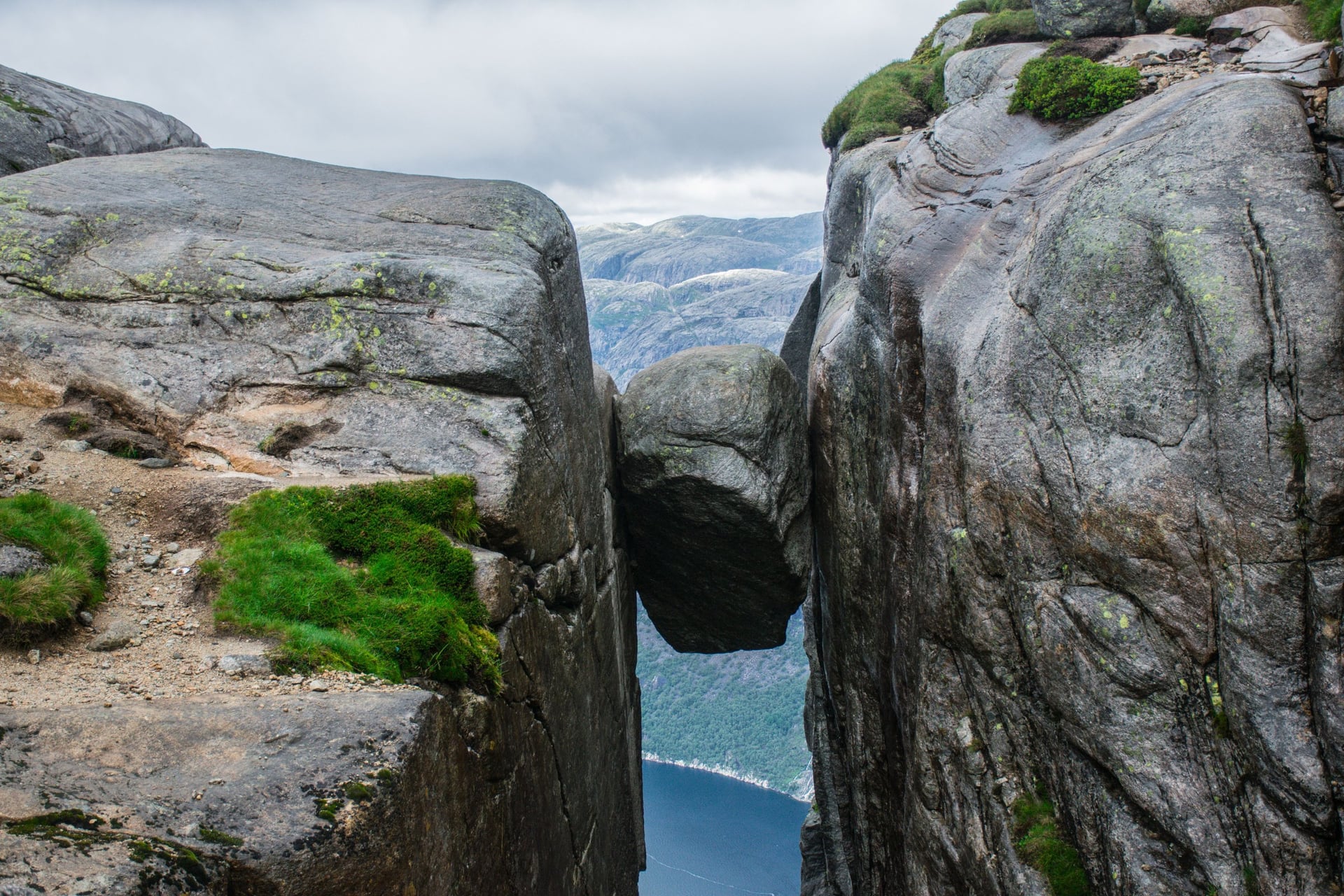
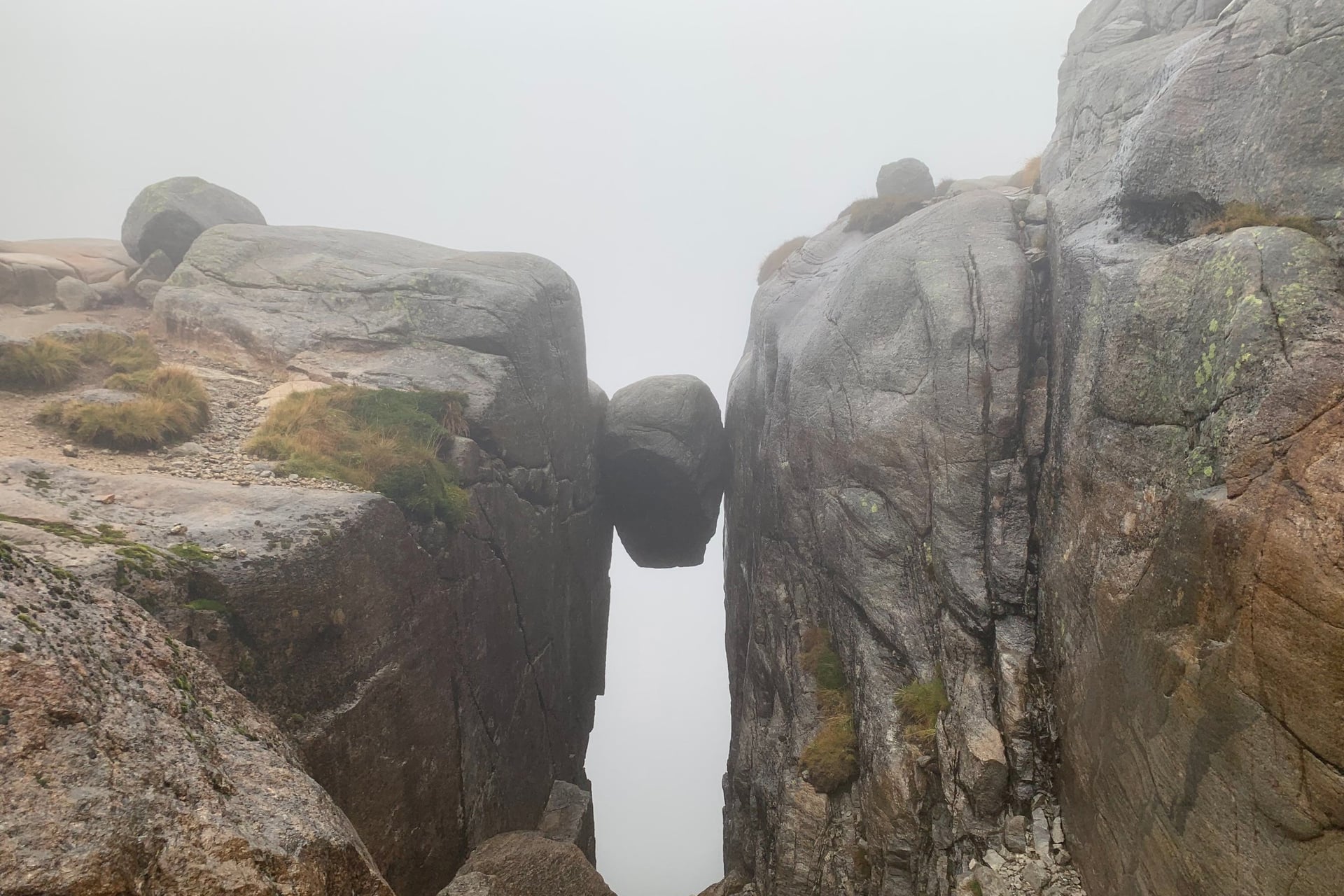
Kjeragbolten is a boulder wedged in a crevasse on the Kjerag massif, 984 m above the Lysefjord. Stepping out onto it is optional, and on busy days you queue for the photo. About 70,000 hikers make the trip each year, on a trail marked with red Ts.
The path crosses three steep climbs with shallow valleys between them, and chains and railings help on the steepest rock. Snow can lie on the trail until mid-June. In 2026 the road to the car park opened on 1 May, and parking costs NOK 300 for more than two hours.
5. Romsdalseggen
Distance: 10 km one way
Time: 5 to 8 hours
Climb: 970 m, up to Mjølvafjellet at 1,215 m
Start: Venjedalssetra, by the Romsdalseggen bus from Åndalsnes, daily from 12 June in 2026
Season: mid-June to the end of September
Where to sleep: Åndalsnes, at the end of the Rauma Line railway
Best for: ridge walkers with a head for heights
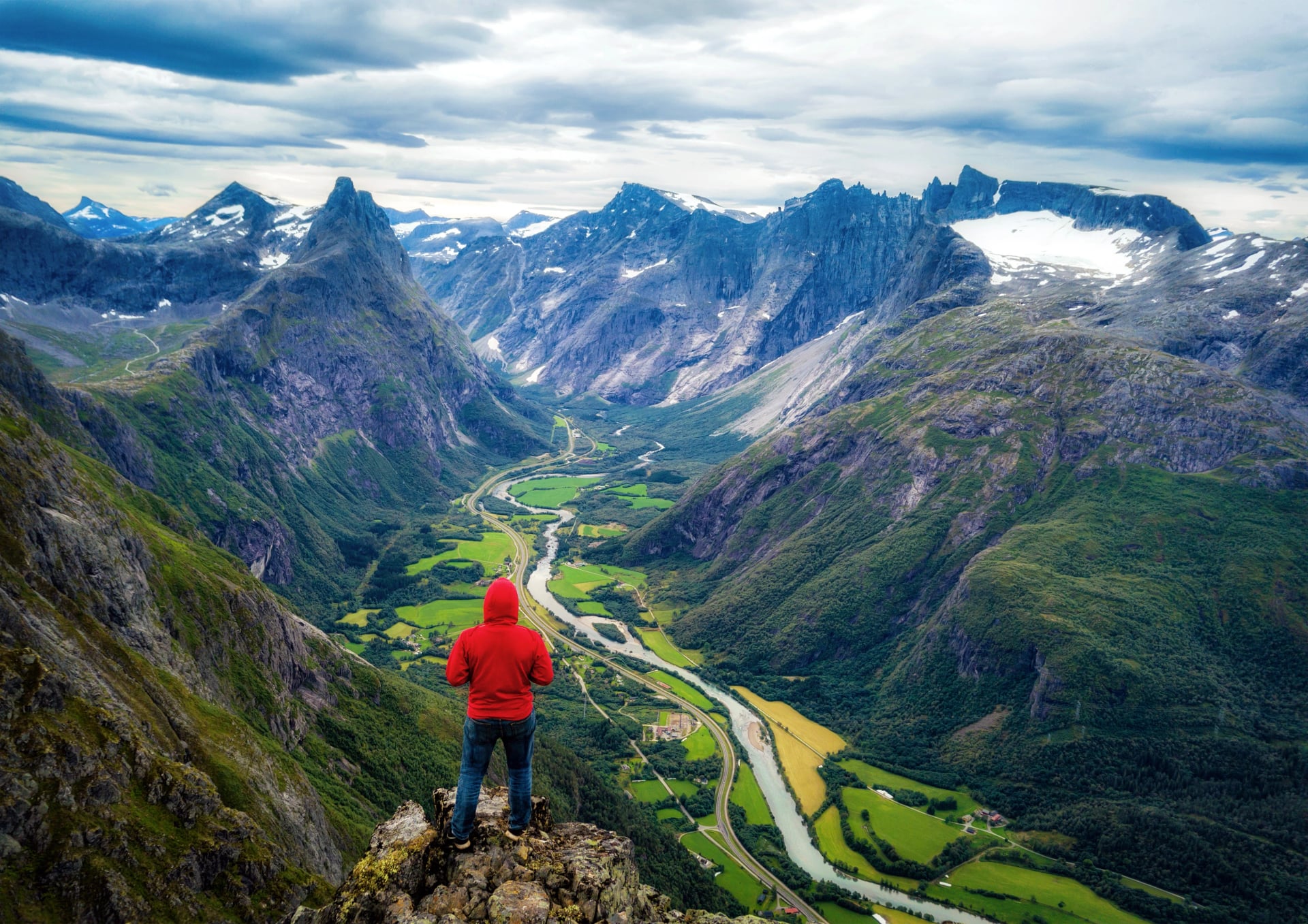
Romsdalseggen is one of Norway's finest ridge walks, with views over Romsdalsfjorden, sharp peaks and Trollveggen, Europe's highest vertical rock face. The route runs one way: the bus takes you to the trailhead, and you walk back down to Åndalsnes.
Halsaskaret is the narrowest section, with chains and some easy scrambling, and it is no place to be in fog or high wind. The last 2 km down the stone steps are steep, so many hikers take the Romsdalen gondola down from Nesaksla instead, at NOK 405 one way in summer 2026.
6. Reinebringen
Distance: 5.8 km return from the Reine Ytre Havn car park
Time: 1 to 2 hours on the steps, plus the walk from Reine
Climb: 484 m, almost all of it on stone steps
Start: the foot of the steps beside the Ramsvik tunnel on the E10, a short walk from Reine
Season: May to September; the steps close in winter
Where to sleep: Reine and the fishing villages of Moskenes
Best for: the classic Lofoten view in a short day
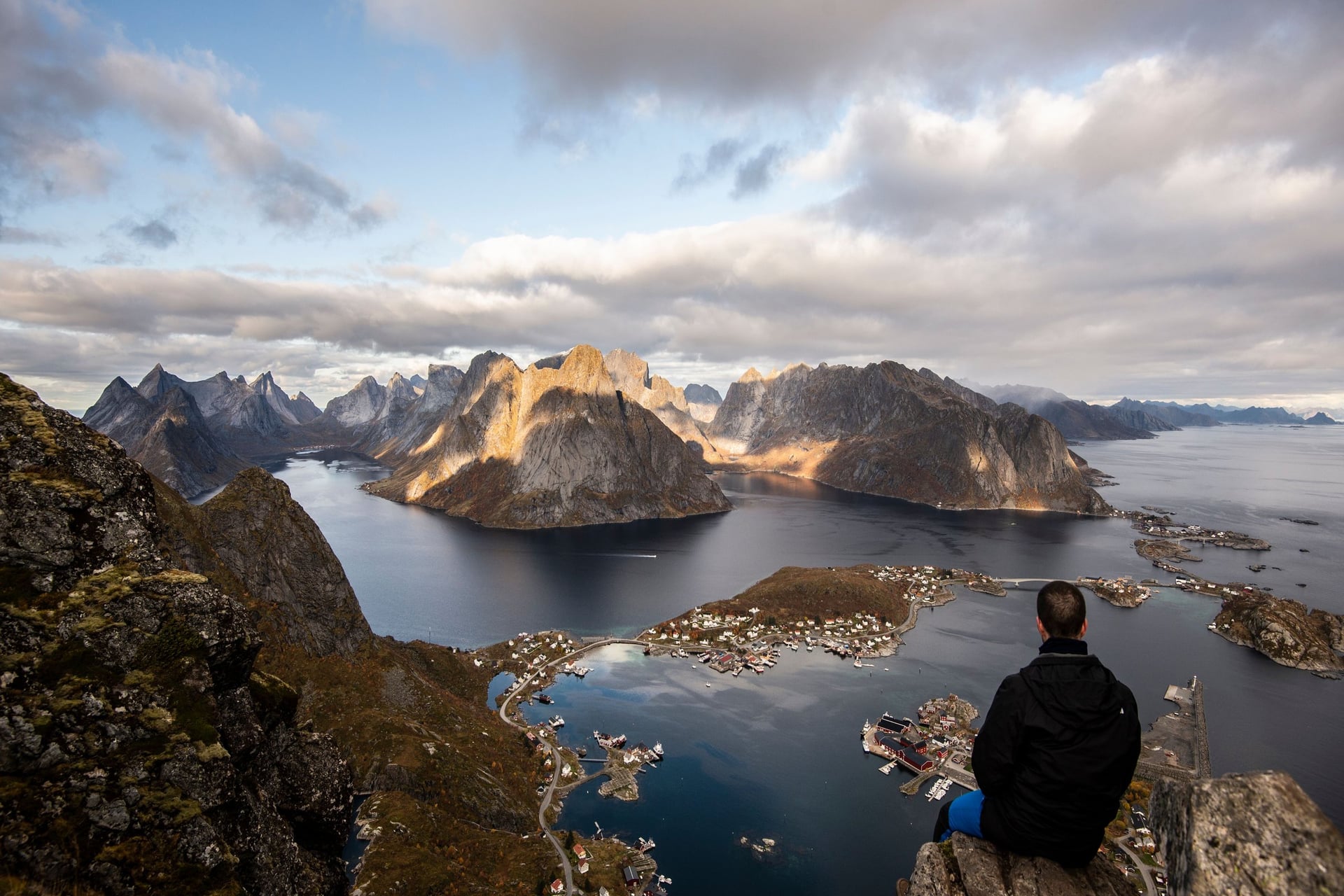
Reinebringen looks down on Reine, its red fishing cabins and the peaks around the Reinefjord. A stone stairway now climbs almost the whole way, 1,974 steps by Visit Lofoten's 2024 count, and the summit is 484 m above the sea.
The steps are steep and exposed, and wind over 10 m/s is dangerous at the top. Moskenes municipality chains the route shut in winter, and ice can form on the steps early in autumn. Park at Reine Ytre Havn, which charged NOK 36 an hour plus VAT in 2026, not along the main road.
The 6 Best Multi-Day Hikes in Norway
Trekking in Norway means linking mountain huts a day's walk apart, so you carry clothes and a sleeping liner, not a tent and stove.
Hike | Region | Distance | Days | Climb | Season |
Jotunheimen Hut to Hut | Jotunheimen | About 95 km loop | 6 | About 3,285 m | July to September |
Aurlandsdalen | Finse to Aurland | About 50 km | 3 to 4 | About 1,200 m up, 2,360 m down | June to September |
Rondane | Rondane | About 60 km loop | 4 | About 1,890 m | June to September |
Trollheimen Triangle | Trollheimen | 58.9 km loop | 3 | About 2,270 m | Mid-June to mid-September |
Hardangervidda | Finse to Haukeliseter | About 120 km | 6 | About 2,400 m | July and August |
St. Olav Ways | Oslo to Trondheim | 643 km | About 32 | Valley stages, then Dovrefjell | June to August |
1. Jotunheimen Hut to Hut
Distance: about 95 km on the classic six-hut loop
Time: 6 days, plus a day for Galdhøpiggen if you want it
Climb: about 3,285 m over the loop
Start: Gjendesheim, by summer express bus from Oslo or by bus from Otta
Season: July to September; the huts are staffed from about 19 June to mid-September
Where to sleep: Gjendesheim, Glitterheim, Spiterstulen, Leirvassbu, Gjendebu and Memurubu, all staffed
Best for: fit hikers who want Norway's highest mountains
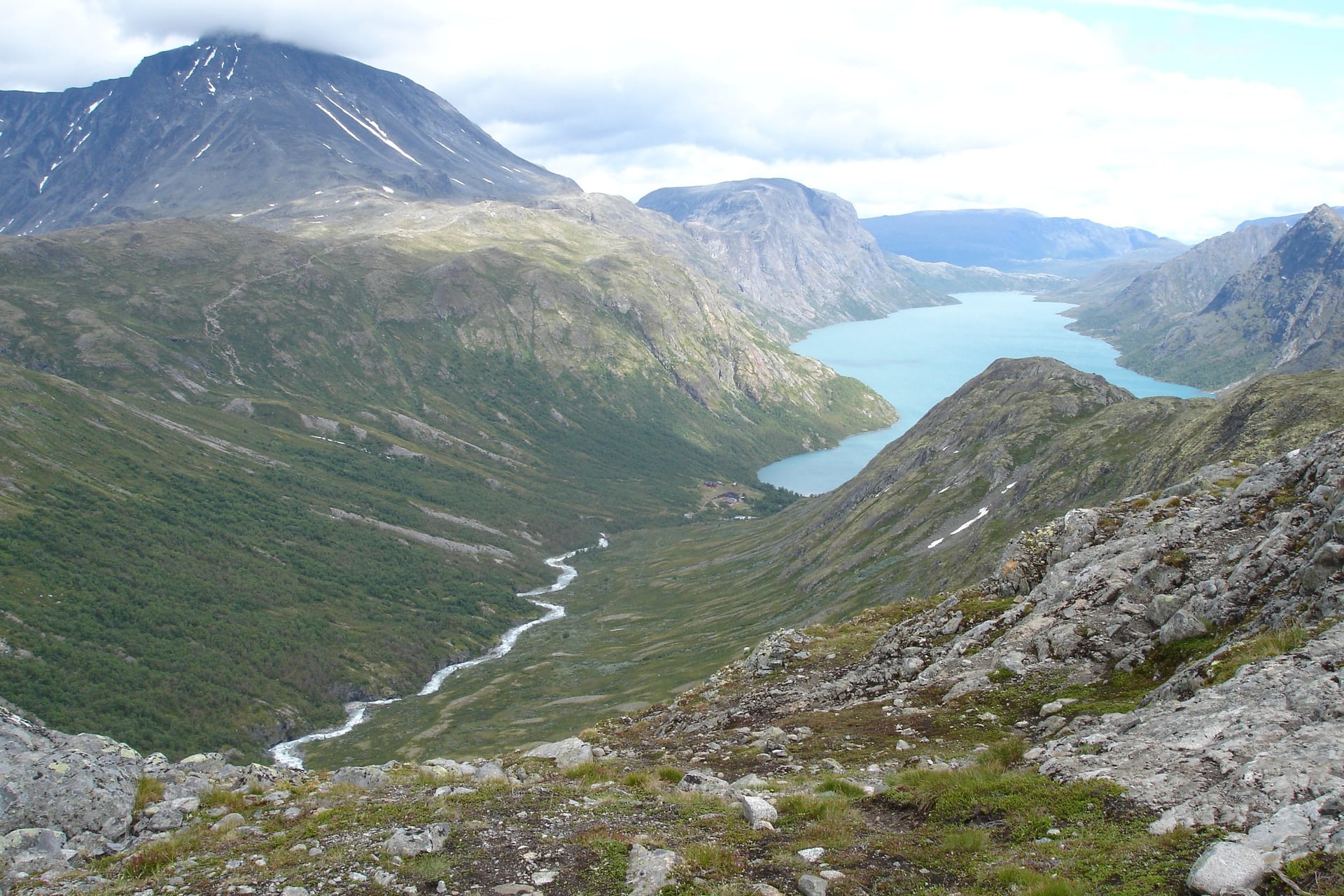
Jotunheimen, the "Home of the Giants", is Norway's alpine heart, with jagged ridges, glacier lakes and over 250 peaks above 2,000 m. No other Norwegian range is as high. The loop climbs from Gjende to Glitterheim, crosses to Spiterstulen and Leirvassbu, then drops to Lake Gjende at Gjendebu, DNT's oldest hut, built in 1871.
Spiterstulen is the base for Galdhøpiggen, at 2,469 m Norway's highest peak and a day's climb from the hut: 12.5 km return with about 1,455 m of climb, with no glacier to cross. The loop ends over Besseggen, so you finish on Norway's most famous ridge.
2. Aurlandsdalen
Distance: about 50 km from Finse to Vassbygdi
Time: 3 days, or 4 with a night at Steinbergdalshytta
Climb: about 1,200 m up and 2,360 m down
Start: Finse station on the Bergen Railway, about 4 hours by train from Oslo
Season: June to September; the lower valley is usually free of snow from mid-May
Where to sleep: Finsehytta, Geiterygghytta, Steinbergdalshytta and Østerbø
Best for: a trek that runs mostly downhill, from the high plateau to the fjord
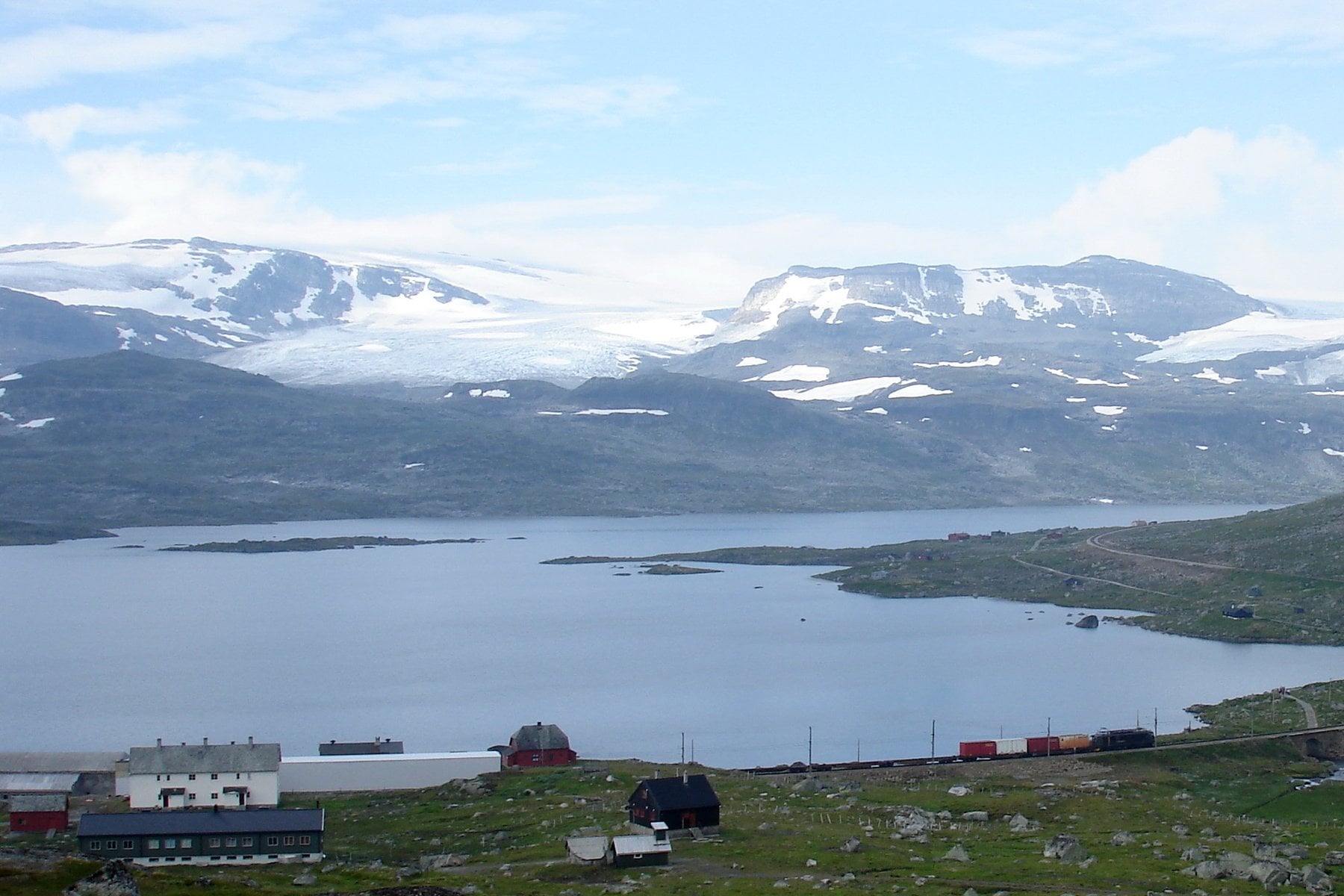
The journey begins high, at Finse, Norway's highest railway station at 1,222 m. From there the trail crosses moors and tarns near 1,600 m to Geiterygghytta, a DNT lodge beside a lake on the edge of the plateau, where snow patches can linger into summer.
Below Østerbø the valley narrows. The trail passes Vetlahelvete, the biggest giant pothole in the valley, and the abandoned farms of Nesbø and Sinjarheim, then drops to Vassbygdi, 80 m above sea level. There is no mobile signal between Vetlahelvete and Vassbygdi, and our Aurlandsdalen guide covers each stage.
3. Rondane
Distance: about 60 km on the classic loop
Time: 4 days
Climb: about 1,890 m
Start: Spranget, above Mysuseter, by summer bus from Otta, then 6 km on a gravel road to Rondvassbu
Season: June to September
Where to sleep: Rondvassbu, Dørålseter and Bjørnhollia, all staffed in summer
Best for: open valleys, wild reindeer and a first hut-to-hut trek
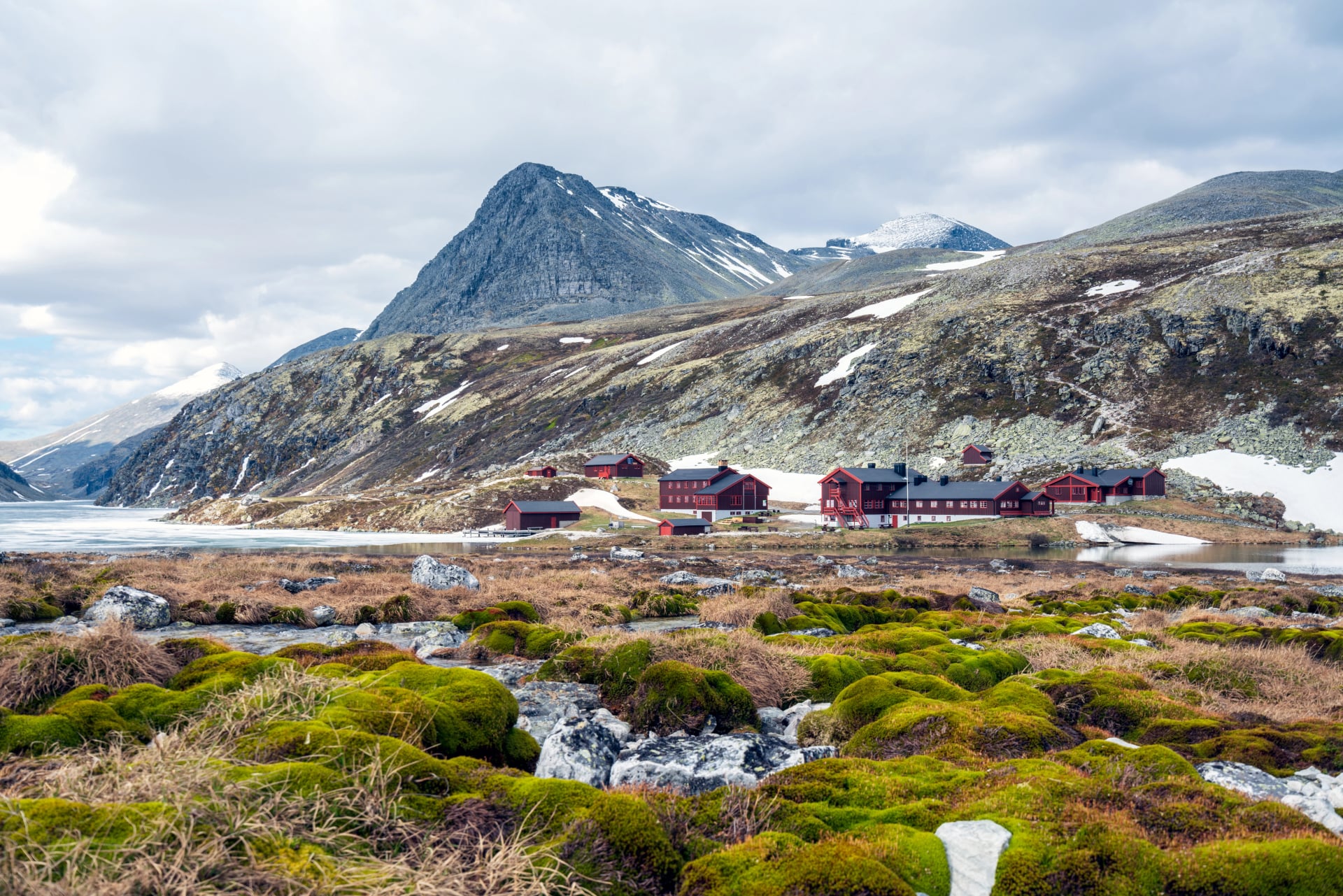
Rondane was Norway's first national park, protected in 1962. Weathered peaks rise above broad valleys shaped by ice, and Rondslottet, at 2,178 m, is the highest. Most hikers start at Rondvassbu, a DNT lodge at the south end of Rondvatnet, and head north through Rondvassdalen to Dørålseter.
From Dørålseter the loop turns through Langglupdalen to Bjørnhollia and back through Illmanndalen. About 3,900 wild reindeer live in the Rondane area, and to protect them the self-service rooms at Rondvassbu and Bjørnhollia closed for good after Easter 2026. A summer boat across Rondvatnet, NOK 200, shortens the walk to Dørålseter.
4. Trollheimen Triangle
Distance: 58.9 km loop
Time: 3 days
Climb: about 2,270 m
Start: Gjevilvasshytta, by road from Oppdal, which is on the Dovre Line railway
Season: mid-June to mid-September, while the three huts are staffed
Where to sleep: Gjevilvasshytta, Jøldalshytta and Trollheimshytta, all run by Trondhjems Turistforening
Best for: long days on good paths without technical ground
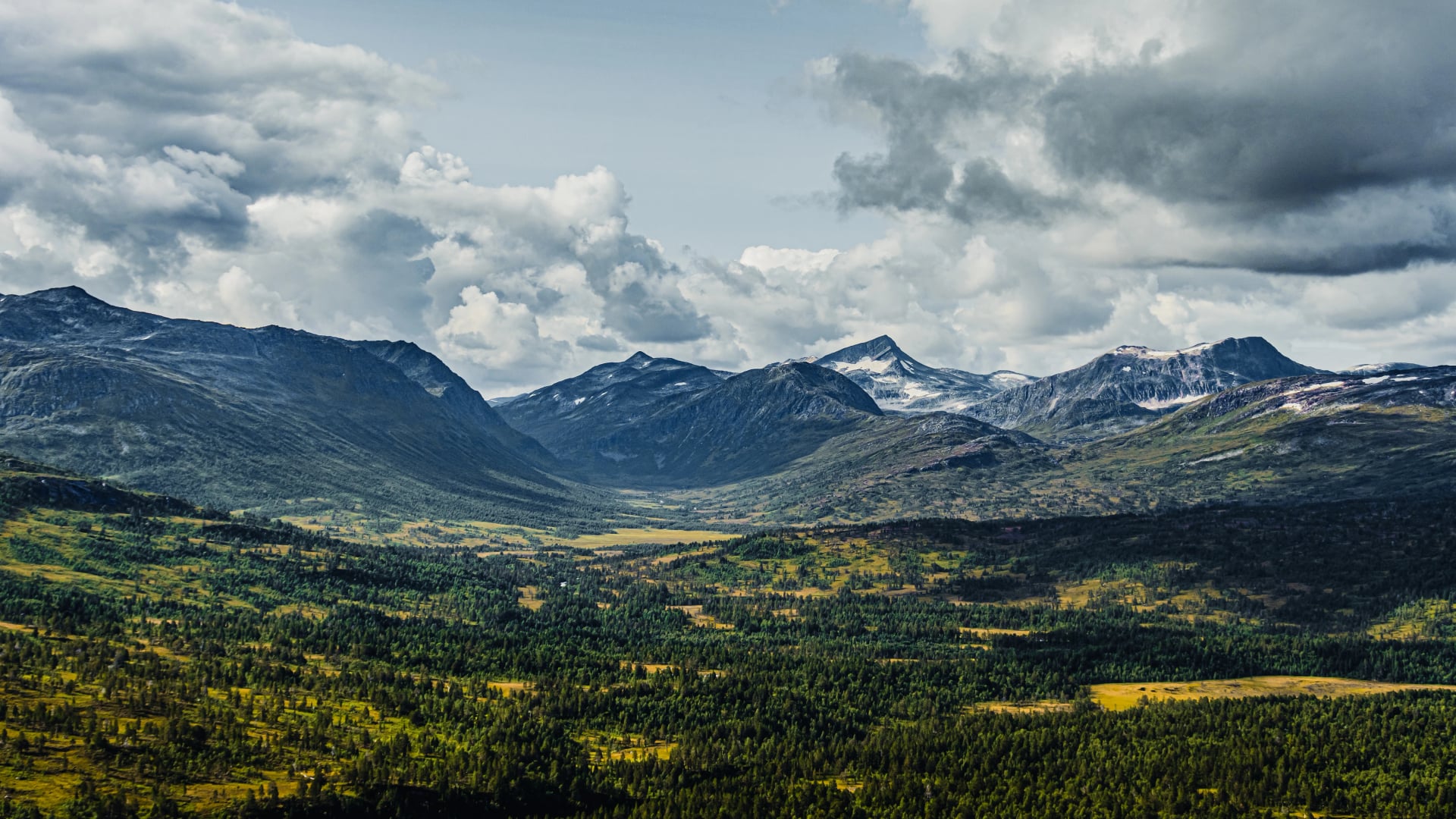
The Triangle, or Trekanten, is the classic way to see Trollheimen: a three-day loop linking Gjevilvasshytta, Jøldalshytta and Trollheimshytta. It was the most visited route suggestion on UT.no in summer 2025, and DNT lists it among Norway's ten most popular mountain trips.
From Gjevilvasshytta, beside Lake Gjevilvatnet, the first day runs 21 km to Jøldalshytta. The second climbs over Geithetta, at 1,325 m, below Trollhetta (1,616 m), and the third returns over Mellomfjell. The stages are long, but the paths are not technical.
5. Hardangervidda
Distance: about 120 km from Finse to Haukeliseter
Time: 6 days
Climb: about 2,400 m
Start: Finse station on the Bergen Railway, which has no road access
Season: July and August for the whole crossing
Where to sleep: Finsehytta, Krækkja, Stigstuv, Sandhaug, Litlos and Hellevassbu, then Haukeliseter
Best for: experienced hikers who want space and solitude
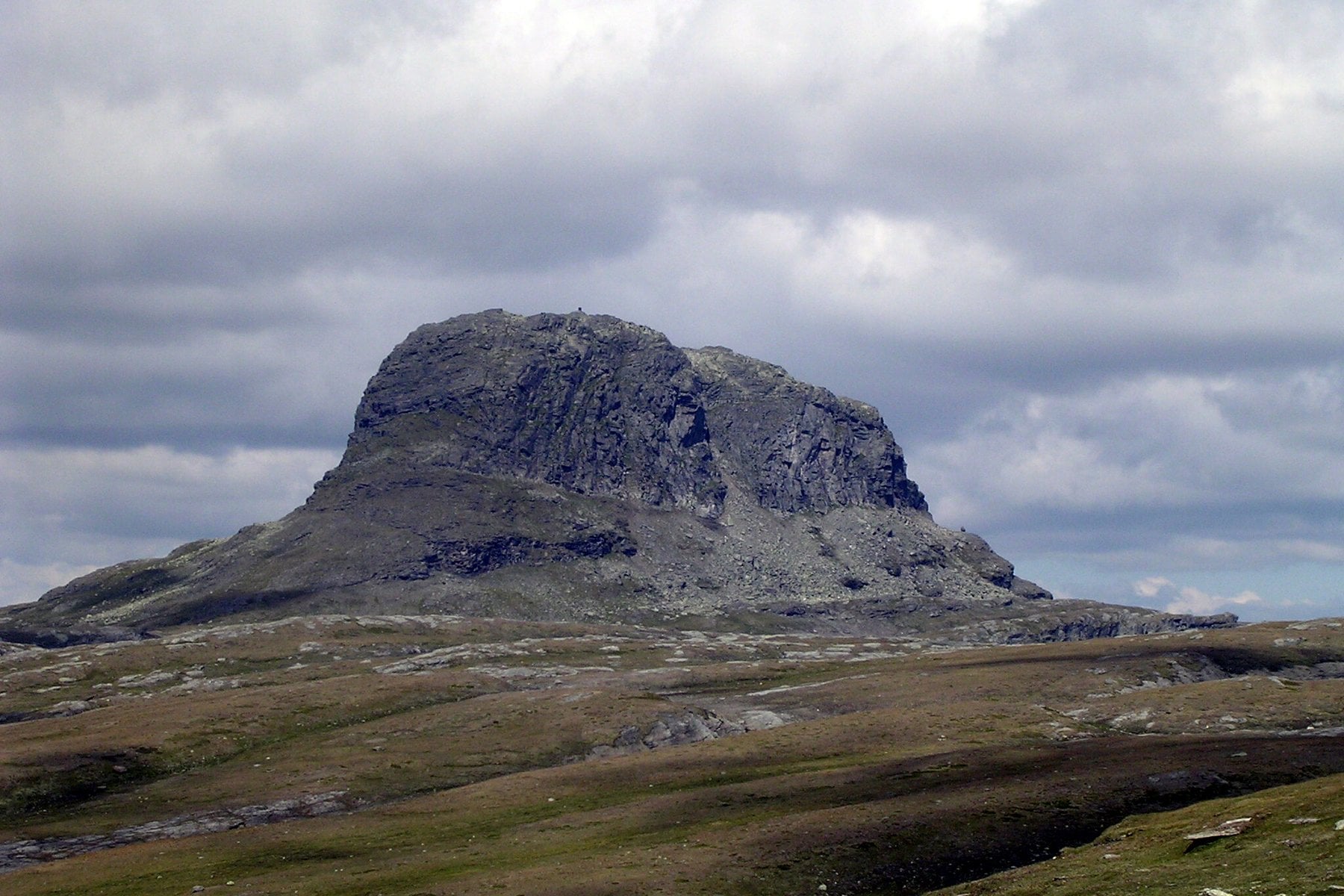
Hardangervidda is Northern Europe's largest mountain plateau, about 8,000 km² of bare, rolling upland. Its national park, protected in 1981, is the largest on mainland Norway, and the classic crossing runs south from Finse, below the Hardangerjøkulen glacier, to Haukeliseter, DNT's busiest hut.
The plateau holds one of Europe's last big wild reindeer herds, around 4,000 animals by the 2023-25 estimate, and Torehytten is closed for five years to protect them. Stages run 17 to 25 km between huts, so carry a map and compass even on marked paths.
6. St. Olav Ways
Distance: 643 km on Gudbrandsdalsleden, the main route
Time: about 32 days, or a week on one section
Climb: long valley stages, then a crossing of Dovrefjell at a little over 1,300 m
Start: the ruins of St. Hallvard's Cathedral in Oslo
Season: June to August; cross Dovrefjell after about 10 June
Where to sleep: pilgrim hostels and farms, such as Budsjord at the foot of Dovrefjell
Best for: walkers who want villages, history and a long journey
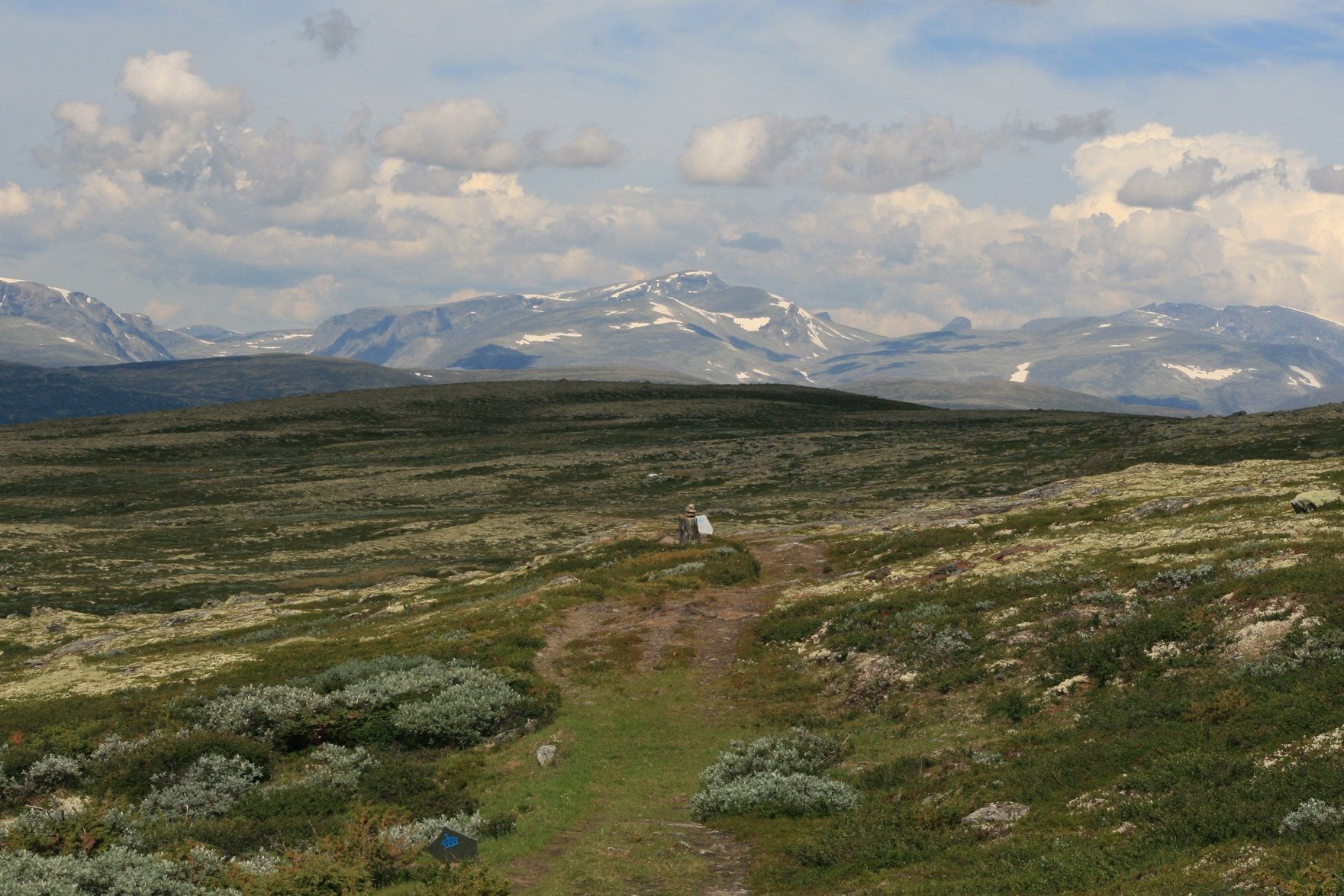
Gudbrandsdalsleden follows the medieval pilgrim road from Oslo to St. Olav's grave at Nidaros Cathedral in Trondheim. It passes Lake Mjøsa, Lillehammer and the farms of Gudbrandsdalen, then crosses about 100 km of open mountain on Dovrefjell, and trains run along almost the whole route.
Walk at least the last 100 km, with stamps in a NOK 50 pilgrim passport, and you can collect the Olavsbrev certificate in Trondheim. In 2025, 1,793 pilgrims registered there, and many aim for Olsok, St. Olav's day, on 29 July.
Where to Stay When Hiking in Norway
In Norway, where you sleep shapes the whole trip. You don't have to choose between wild and comfortable: you can walk from hut to hut, carry a tent or hike from a valley hotel.
DNT Mountain Huts
On most multi-day routes you stay in a DNT hut, part of the Norwegian Trekking Association's network of over 600 huts. They aren't fancy, but they let you stay in the mountains without a tent or stove. Our guide to Norway's mountain huts explains how each type works.
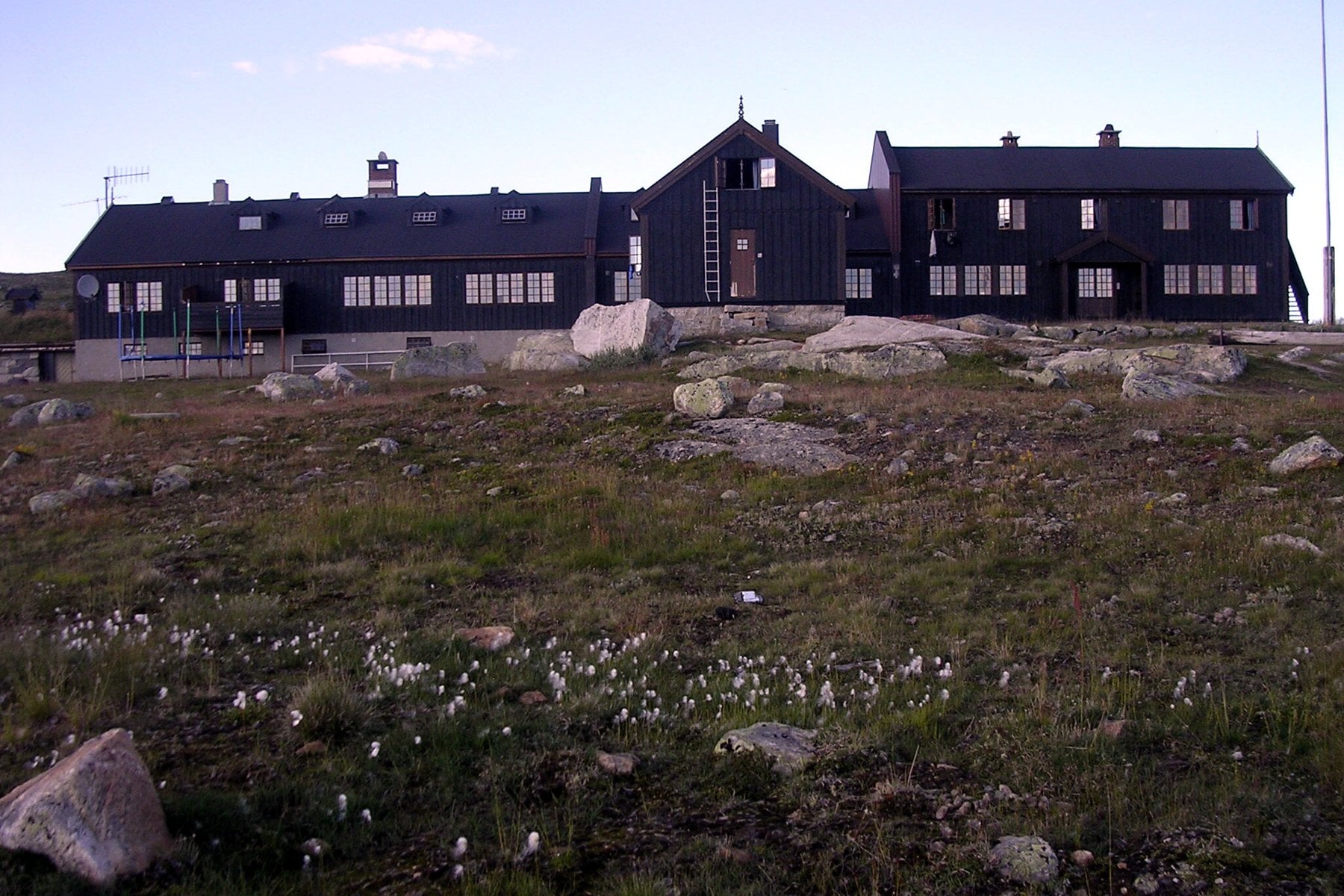
Huts come in three types:
Staffed lodges (betjent): hosts serve breakfast and a three-course dinner, and most have showers and a drying room; open mainly from mid-June to mid-September
Self-service huts (selvbetjent): unstaffed, with beds, firewood and a pantry of food you pay for yourself; locked with the DNT key, which members can borrow for a NOK 100 deposit
No-service huts (ubetjent): beds, blankets and cooking gear but no food for sale
Bring a sleeping liner, because blankets and pillows are provided. Book popular huts for July and August at hyttebestilling.dnt.no, although staffed huts keep some beds for walk-in guests and DNT's rule is that no one is turned away. Late arrivals may get a mattress on the floor.
Wild Camping
If you want total freedom, carry a tent. Under the right to roam (allemannsretten), you can camp on uncultivated land in the mountains, forests and along the coast.
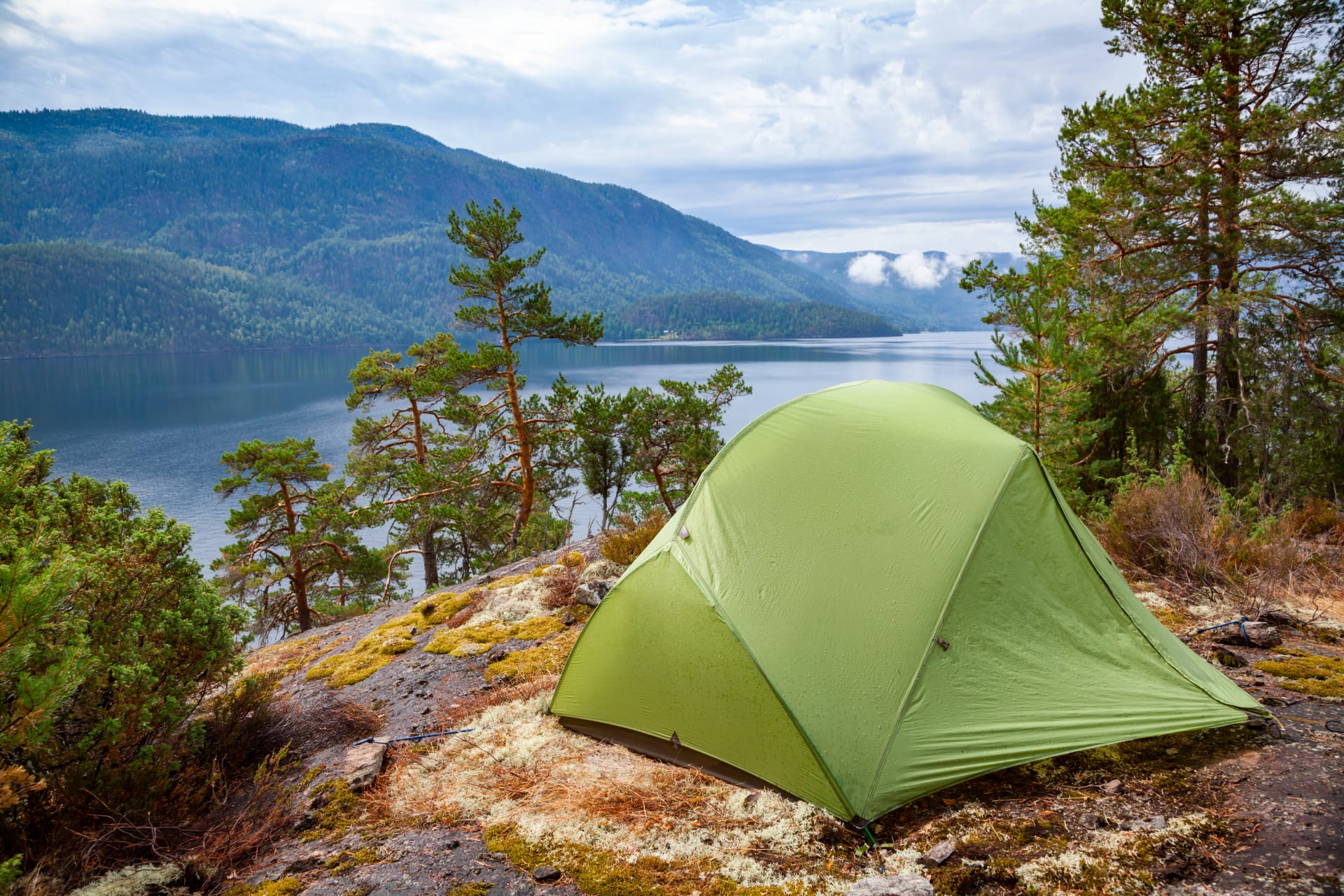
The rules are simple:
150 m from houses: pitch at least 150 m from the nearest house or cabin
Two nights: stay up to two nights in one spot, or longer in the high mountains far from houses
No fires in summer: campfires are banned in or near forest and other open land from 15 April to 15 September
Leave no trace: pack out all rubbish and never wash dishes directly in streams or lakes
Wild camping is especially rewarding on Hardangervidda and in Rondane, where solitude is part of the landscape. National parks and reindeer areas can add local limits, so read the signs at the trailhead.
Hotels and Guesthouses
Not every hiker wants bunk beds and a shared washroom. Åndalsnes, Lom, Odda and Aurland have small hotels and guesthouses close to the trails, so you can hike from one base for several days. In Flåm or Geiranger, short hikes combine well with boat trips, which suits families.
Some mountain lodges are private hotels with their own rooms. Spiterstulen, at 1,106 m below Galdhøpiggen, sleeps 280 and is staffed from late May to 20 September. At Preikestolen, Preikestolen Fjellstue stands at the trailhead, so you can be on the path before the buses arrive.
Best Time to Hike in Norway
Norway's hiking season is set by altitude and latitude, and for most mountain routes the best time is late June to mid-September, when the staffed huts are open.
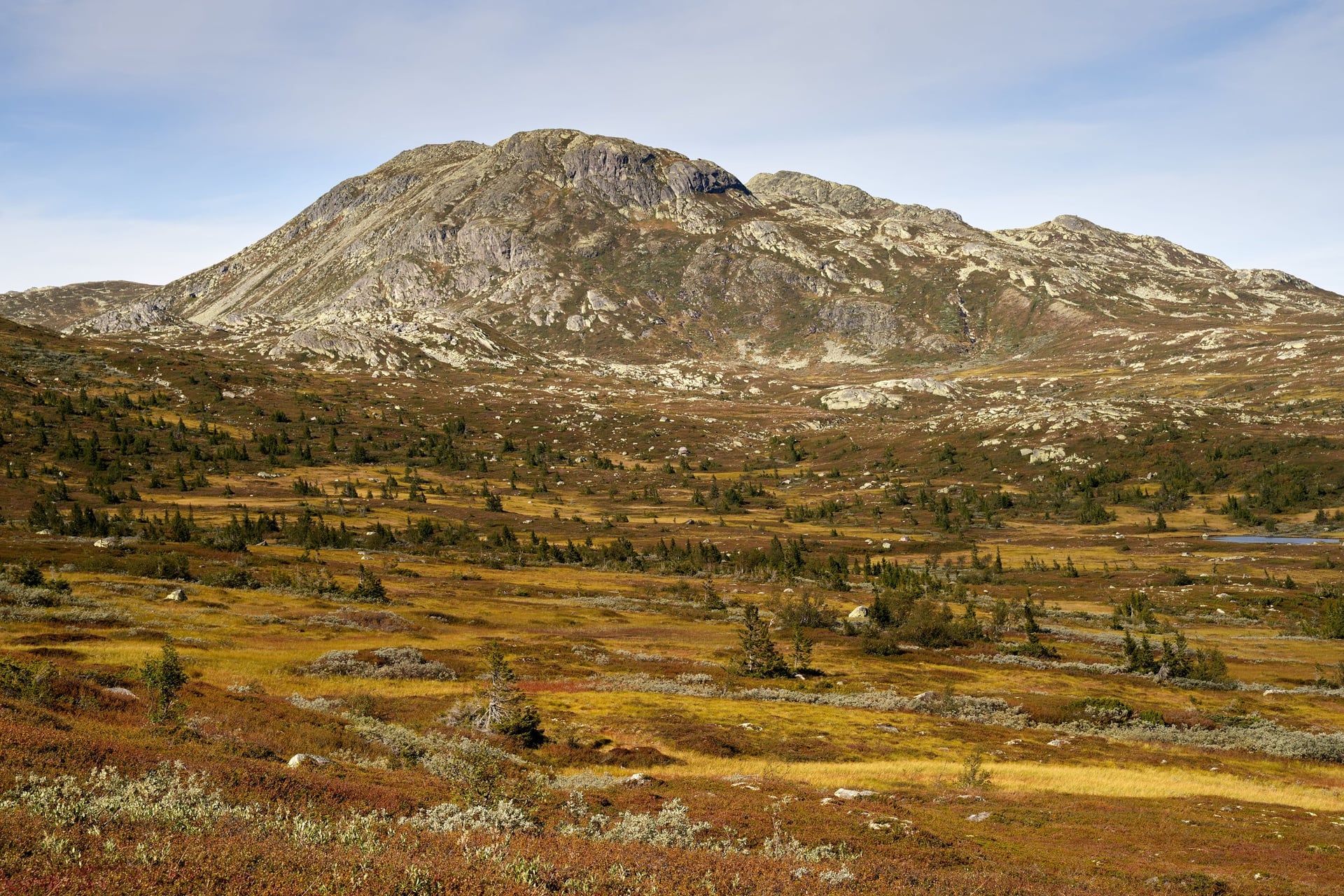
Early summer (mid-June to early July): the staffed huts open around 19 June, but snow and meltwater can linger on high routes into early July, and DNT advises against high-mountain hiking during the May and June melt
High summer (July and August): everything is open, and at Fokstugu on Dovrefjell July days average 16 °C, falling to 6.5 °C at night; in Lofoten the midnight sun lasts from 28 May to 14 July
Autumn (September): cooler days, fewer people and the birch turning gold, but most staffed huts close around 13 September
Winter (October to May): skiing season, not hiking season; most trails lie under snow, and roads such as the one to Kjerag close
Rain depends on the region. The west coast is far wetter than the inland mountains: Bergen gets about 2,500 mm a year, with rain on roughly 200 days, while Fokstugu, east of the main mountains, gets about 450 mm. Our best time to hike in Norway guide goes through it month by month.
How Hard Is Hiking in Norway?
Norwegian trails are less about speed than stamina and sure footing, because even short hikes cross rock, bog and snow, and many have no built path at all.
Terrain and Waymarking
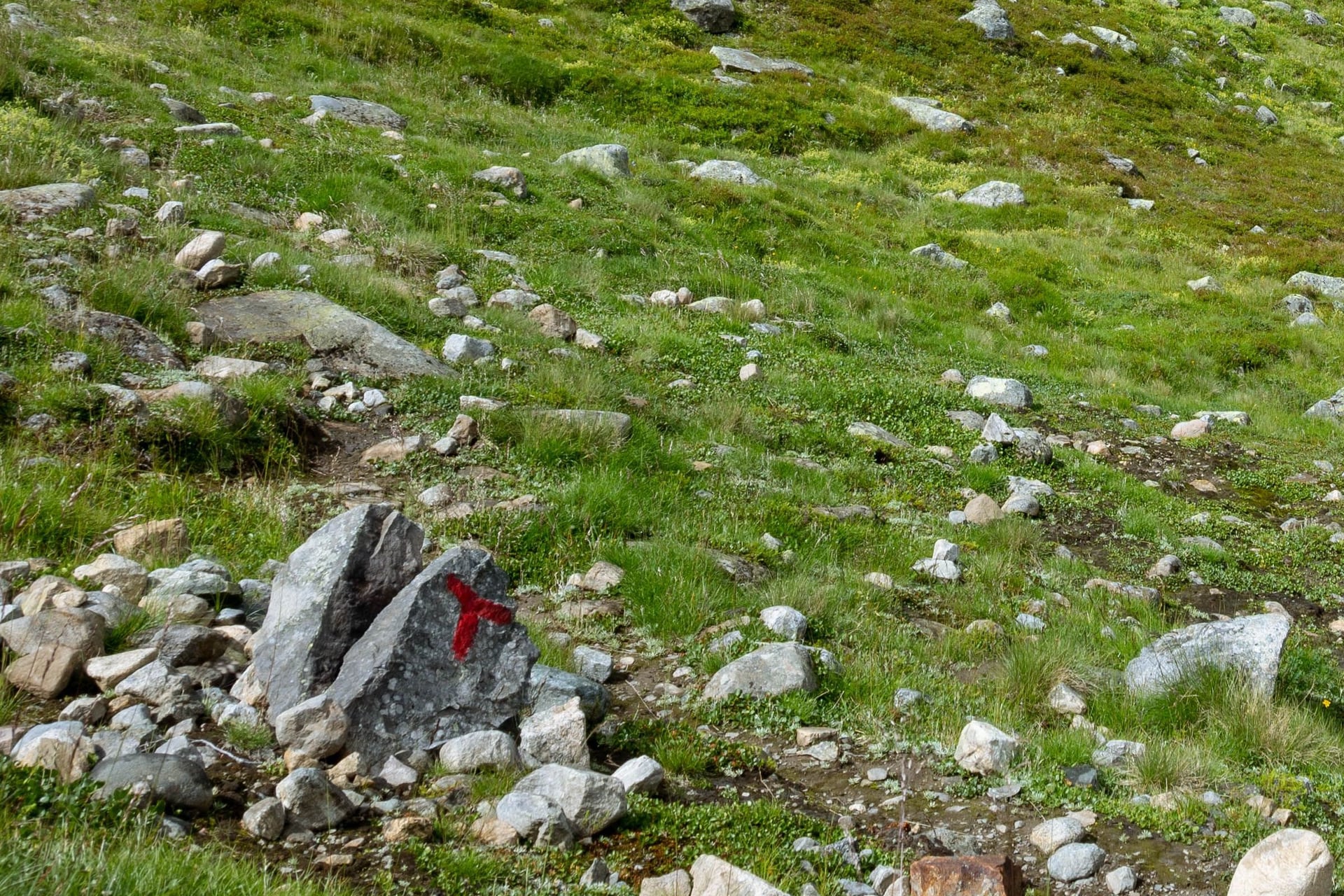
Trails range from gravel roads to steep, boulder-strewn routes marked only by cairns, and most are wet, rocky or snow-covered depending on the season. DNT marks its summer trails with red Ts painted on cairns and rocks, placed so you can see the next one even in fog.
Trails are graded green, blue, red or black. A red trail is for experienced hikers: up to 1,000 m of climb and 20 km, on narrow, rocky ground where you may need your hands. UT.no, DNT's planning site, grades its route suggestions on the same scale.
Daily distances on hut routes are typically 10 to 20 km, but climb, terrain and pack weight make every kilometre count. The Trollheimen Triangle's stages run 16 to 21 km, and a staffed hut is the only shelter between them.
Weather and Snow
Norwegian mountain weather changes fast, even in summer. A trail that starts in sunshine can end in sleet or fog, and exposed ridges feel far colder than the valley forecast. At Juvasshøe, 1,894 m up in Jotunheimen, the July average is just 5.4 °C.
Check yr.no, run by the Norwegian Meteorological Institute and NRK, every morning on a multi-day trip. Varsom.no adds warnings for avalanches, floods and landslides, which matter in early summer while the snow is still melting.
Safety in the Mountains
Norway's Mountain Code (Fjellvettreglene), revised by DNT and the Red Cross in 2016, sums up how to stay safe in nine rules. They include planning your trip and telling others your route, adapting it to the conditions and never being ashamed to turn around.
In an emergency, call 112 for the police, who run mountain rescue, or 113 for medical help. Mobile signal drops out in deep valleys such as lower Aurlandsdalen, so carry a paper map and compass as well as an app.
Know Before You Arrive
Planning a Norway hiking trip comes down to long distances between trailheads, and to the boats, buses and beds that run only in summer.
Getting to the Trailheads
Despite its wild image, Norway is easy to reach, but distances are long: most hikes are a train, bus or boat ride from an airport.
Oslo: for Jotunheimen, Rondane and Hardangervidda; trains reach Otta in about 3½ hours and Finse in just over 4
Bergen: for Aurlandsdalen and the Hardangerfjord; a summer shuttle bus runs from Odda to Trolltunga's P2 car park
Stavanger: for Preikestolen, 50 minutes by bus, and Kjerag, by the Kjerag Express in summer
Trondheim: for Trollheimen by train to Oppdal, and the end of the St. Olav Ways
Åndalsnes: for Romsdalseggen, on the Rauma Line from Dombås
Bodø or Leknes: for Lofoten; the direct Bodø to Moskenes ferry takes about 3¼ hours, and foot passengers travel free
Summer buses and boats make one-way hikes easy without a car. Besides the Gjende boat, in 2026 mountain buses ran from Lom and Otta to Spiterstulen, Leirvassbu and Spranget, from 22 June to 16 August. A car helps for trailheads like Kjerag, but parking at the famous hikes costs NOK 275 to 600 a day.
How Much It Costs
Norway is expensive, but hiking itself is free: there are no park fees, so the costs are beds, meals, parking and transport.
These were the 2026 prices in Norwegian kroner (NOK):
Staffed DNT hut with full board: NOK 1,315 for members and 1,710 for non-members, with bed, breakfast, dinner and a packed lunch (DNT Oslo og Omegn huts)
Dormitory bed only: NOK 290 for members and 382 for non-members
Self-service hut: NOK 340 for members and 520 for non-members, plus food from the pantry
DNT membership: NOK 860 for an adult in 2026, rising to 885 in 2027
Parking: NOK 275 at Preikestolen, 300 at Kjerag and 550 a day at Trolltunga's P2
Boats: NOK 260 for the Gjende boat to Memurubu and 200 across Rondvatnet
Membership pays for itself after three nights of full board, and it lets you borrow the DNT key. A 3% municipal tax on overnight stays is allowed from July 2026, but the first areas, including Tromsø and Lofoten, plan to collect it from 2027.
What to Pack
Hiking in Norway calls for reliable layers rather than ultralight kit, because even in July you may cross snowfields or get soaked by a sudden fjord wind. Avoid cotton, jeans included: once it's wet, it stays that way.
For any hike:
Base layer: merino wool or synthetic, never cotton
Mid layer: a fleece or a light insulated jacket
Shell: a waterproof, windproof jacket and trousers
Hat and gloves: always, even in midsummer
Boots: sturdy, waterproof and broken in, with ankle support for rocky routes
Map and compass: plus an offline map app such as UT.no or Norgeskart
First-aid kit and head torch: with blister care and any personal medicine
For a hut-to-hut trek:
Sleeping liner: required in DNT huts, where blankets and pillows are provided
A 30 to 45 litre pack: enough from hut to hut; 55 to 70 litres if you camp
Trekking poles: for steep descents and boggy ground
Earplugs: for hut dormitories
Camp shoes: light sandals for the huts and river crossings
The DNT app: to pay at self-service and no-service huts, even without signal
Booking a Hut-to-Hut Trek in Norway
The hard part of a hut-to-hut trek in Norway is the timing, because the staffed huts open for only about 12 weeks a year.
In 2026 most staffed huts on these routes, sleeping 64 to 280 guests at 700 to 1,400 m, ran from 19 June to about 13 September. Only some beds can be booked online, the Gjende and Rondvatnet boats run to their own timetables, and members pay about a quarter less for full board.
Our self-guided tours book that chain of huts for you, with meals in the huts, a digital guidebook and a GPS app. You can ask us about dates for next summer.
Jotunheimen Hut to Hut: the Jotunheimen Hut-to-Hut Trek, 8 days / 7 nights from Gjendesheim, via Glitterheim, Spiterstulen, Leirvassbu, Gjendebu and Memurubu, with an optional day for Galdhøpiggen and Besseggen on the last walking day
Besseggen and Gjende: Jotunheimen Highlights, 4 days / 3 nights, with Besseggen and the Bukkelægret crossing from Memurubu to Gjendebu
Rondane: the Rondane National Park Hiking Tour, 5 days / 4 nights from Otta, round Rondvassbu, Dørålseter and Bjørnhollia
Trollheimen: the Trollheimen Triangle Route, 5 days / 4 nights from Gjevilvasshytta
Aurlandsdalen: the Aurlandsdalen Hut-to-Hut Hike, 6 days / 5 nights from Finse to Aurlandsvangen, with hut and hotel nights
Whichever route you pick, the best days end the same way: boots drying in a hut by Lake Gjende, with the light still on the peaks at ten in the evening.
Frequently Asked Questions



Plan with a hiking expert
Free advice from a team that knows these routes inside out - real people, not a bot

HASSLE-FREE
We handle itineraries, accommodations, and anything else you prefer not to deal with, so you can enjoy a carefree hike.

BOOK WITH CONFIDENCE
We are a financially protected company, fully bonded and insured, keeping your money safe and allowing you to travel with confidence.

TRIED & TESTED ADVENTURES
Only the best hut to hut hikes in Europe, cherry-picked by our local team with an in-depth knowledge of the region.

UNBEATABLE SUPPORT
Our 24/7 customer support is where we show our passion, bringing you a better experience by making your well-being our number one priority.